
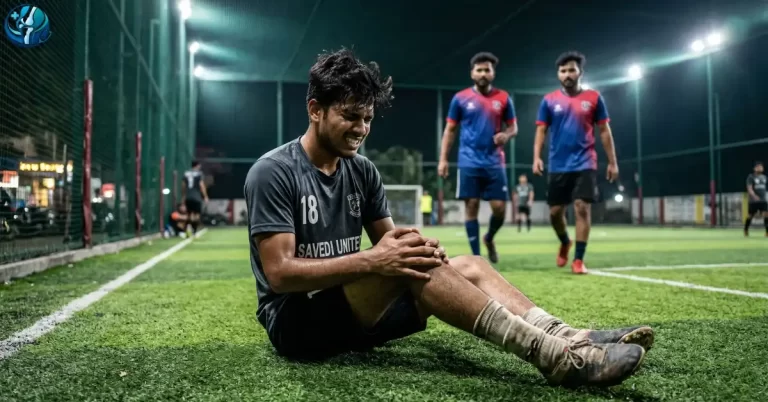
Summer evenings are here. Right now, every artificial turf in Savedi and across the city is fully booked for cricket and football. But playing hard on these artificial grass grounds comes with a big risk. Sudden stops and sharp twists are causing many severe knee injuries for young players. If you hear a loud “pop” in your knee while playing, you must consult a sports injury doctor in Ahilyanagar immediately.
Imagine this happens to you. You run for a catch or turn quickly to kick the football. Suddenly, your knee makes a popping sound. You limp off the field, and your knee starts swelling fast.
Most players just use a pain relief spray, wrap the knee in a bandage, and hope it is a minor sprain. They just want to play again next weekend. As an orthopedic doctor, I strongly tell my patients to stop doing this. Waiting and watching can ruin your knee forever.
Here is a simple guide. Learn how to check your knee pain, understand why artificial turf is risky, and know exactly when to get medical help before the damage becomes permanent.
The Artificial Turf Trap: Why Knee Ligaments Tear
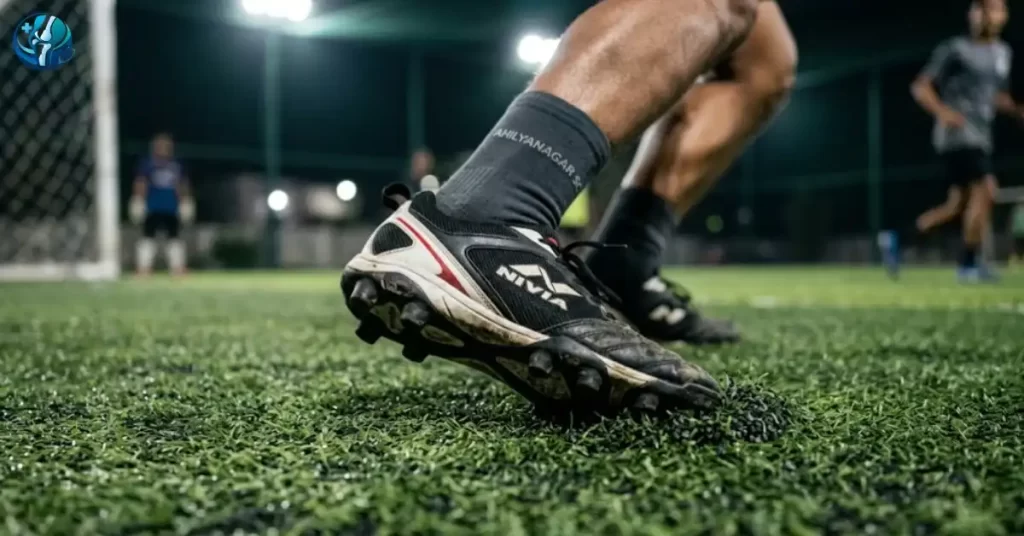
Let us look at why these turf injuries happen so often. Natural mud or grass naturally gives way when you slide or turn. Artificial turf does not. The synthetic grass creates a very high level of friction.
When you wear sports shoes with rubber studs and make a sharp turn on turf, your foot locks firmly into the ground. However, the rest of your body keeps moving. Because your foot is stuck, all that twisting force goes straight into your knee joint.
This sudden twisting is the number one reason young athletes in Savedi suffer from Anterior Cruciate Ligament (ACL) tears and meniscus injuries. The turf holds your foot, your knee twists too far, and the ligament simply snaps under the extreme pressure.
Minor Sprain or Torn ACL: How to Tell the Difference
After a fall on the turf, you need to know exactly what you are dealing with. Is it just a minor stretch, or did a ligament actually tear? Here is a simple checklist to help you self-assess the injury before you visit the clinic.
Signs of a Minor Knee Sprain
- Mild Swelling: The knee looks slightly puffy but generally keeps its normal shape.
- Walking is Possible: You can put weight on the leg and walk with only a slight limp.
- Manageable Pain: The joint has a dull ache. This pain improves quickly after applying an ice pack and resting.
Signs of a Torn ACL (Medical Red Flags)
- The “Pop” Sound: You heard or felt a distinct snap inside the knee at the exact moment of the injury.
- Rapid Swelling: The knee balloons up and feels extremely tight within just two hours of the fall.
- Severe Instability: Your knee feels incredibly loose or wobbly. It feels like the joint will completely “give out” or buckle if you try to stand on it.
If you experience any of these red flags, a basic painkiller and a crepe bandage will not fix the problem. You are dealing with a structural injury that requires immediate clinical attention.
Which Doctor Should You Consult for a Sports Injury?
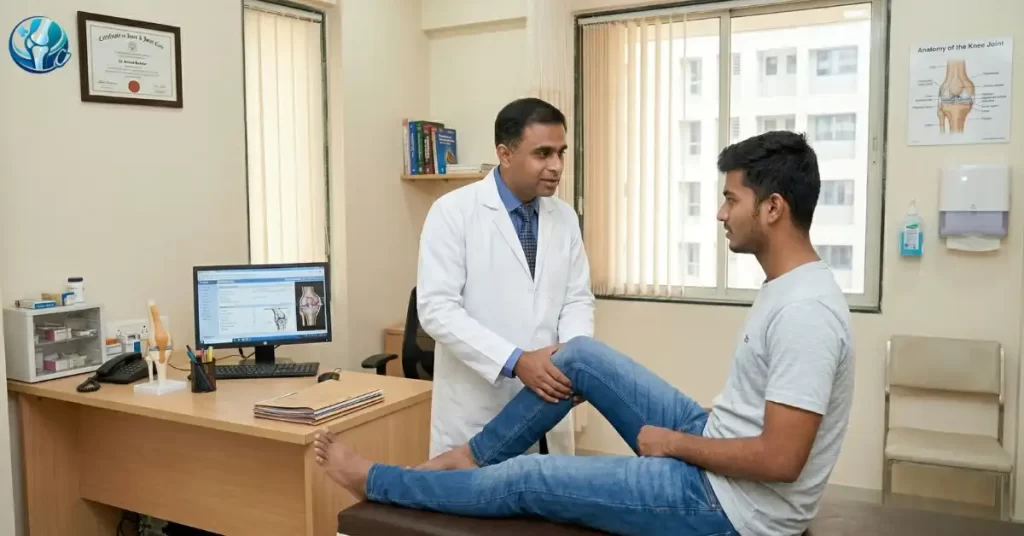
When you get hurt on the turf, your first thought might be to visit a local general physician for pain medicine. However, for a suspected ligament tear, you need specialized care. You should immediately consult an orthopedic surgeon who focuses heavily on sports medicine.
Consulting a dedicated sports injury expert like Dr. Avinash Gadekar provides crucial advantages:
- Targeted Physical Exams: He will physically test your knee for specific joint laxity to pinpoint the exact tear.
- Turf Expertise: He understands the exact mechanics and twisting forces of local artificial grass injuries.
Precise Diagnostics: He knows exactly which specific MRI scans to order so he can see the hidden ligament damage clearly.
The Hidden Danger of the "Wait and Watch" Approach
Many young athletes make a terrible mistake after a knee pop. They rest for two weeks, feel a little better, and go straight back to the Savedi football turfs. This is incredibly dangerous.
Running, jumping, or pivoting on an unstable knee leads to severe consequences:
- Loss of Stability: Your knee is forced to operate without its main structural stabilizer.
- Cartilage Destruction: The unnatural movement will literally crush your meniscus cartilage with every step.
- Early Arthritis: This turns a highly fixable sports injury into severe, early-onset arthritis by the time you reach your mid-thirties.
Do not risk your permanent mobility just to play one weekend game.
Keyhole Arthroscopy: Your Fast Track Back to the Pitch
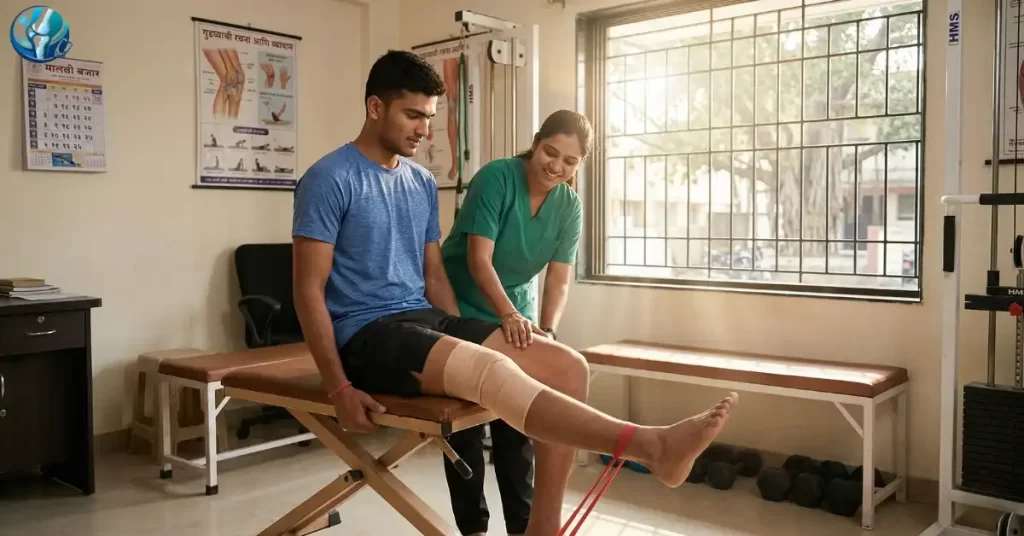
The good news is that a torn ligament is no longer a permanent end to your active lifestyle. Dr. Avinash Gadekar specializes in advanced keyhole arthroscopy at Neuron Plus Hospital.
This modern, minimally invasive procedure offers massive benefits for young athletes:
- Tiny Incisions: We use a small camera to repair the torn ligament precisely without opening the entire knee.
- Less Pain: The minimally invasive approach means significantly less post-operative pain.
- Minimal Scarring: You completely avoid the large, visible scars of traditional open surgery.
- Faster Recovery: A quicker healing timeline combined with a structured physiotherapy plan gets you back to your favourite sports safely.
You can learn more about how this advanced technique works on our dedicated Arthroscopy and Sports Injuries page.
Book Your Checkup with a Top Sports Injury Doctor in Ahilyanagar
If your knee is swollen and painful from last night’s cricket match, please stop walking on it immediately. Getting a proper clinical diagnosis today is the only way to save your joint for tomorrow.
Do not let a turf injury keep you on the bench all summer. Take the right medical action today:
- Stop playing and apply ice to the swollen joint.
- Book your consultation with Dr. Avinash Gadekar.
- Get a clear, honest assessment of your exact knee health.
Visit our Contact Us page to schedule your appointment, or call the hospital directly at 09420031389 to speak with our clinical team.
Frequently Asked Questions: Turf Injuries & Knee Pain
Q1. How do I know if my knee injury from turf cricket is serious?
Ans: A minor sprain usually involves mild swelling and manageable pain. However, a serious structural injury has clear red flags. If you heard a distinct “pop” sound during the fall, experienced rapid swelling within two hours, or feel like your knee will buckle when you stand on it, you likely have a torn ligament. You need immediate clinical evaluation.
Q2. Which doctor should I consult for a sports injury in Ahilyanagar?
Ans: You should bypass general physicians and consult an orthopedic surgeon who specializes directly in sports medicine and arthroscopy. A dedicated sports injury doctor like Dr. Avinash Gadekar knows how to perform targeted physical joint tests. He will also order the exact MRI sequence needed to reveal hidden ACL or meniscus damage.
Q3. Can a torn ACL heal on its own with enough rest?
Ans: No. A completely torn Anterior Cruciate Ligament cannot naturally heal itself. Resting for a few weeks will reduce the initial swelling, but your knee will remain fundamentally unstable. Returning to the turf with an untreated tear will crush your meniscus cartilage and trigger early-onset arthritis.
Q4. Does a sports-related knee injury always require open surgery?
Ans: Absolutely not. Modern orthopedic care focuses on minimally invasive solutions. If you do have a severe ligament tear, Dr. Gadekar performs advanced keyhole arthroscopy at Neuron Plus Hospital. This modern technique uses tiny incisions and a small camera to repair the joint. It guarantees less pain, minimal scarring, and a much faster recovery timeline.
Q5. How quickly can I return to playing football after a turf knee injury?
Ans: This timeline depends entirely on a proper clinical diagnosis. A minor sprain might only require two to three weeks of guided rest and physiotherapy. Recovering from an arthroscopic ligament repair requires a highly structured, multi-month rehabilitation program. A physical checkup is the only way to get a safe and accurate timeline for your return to the pitch.