

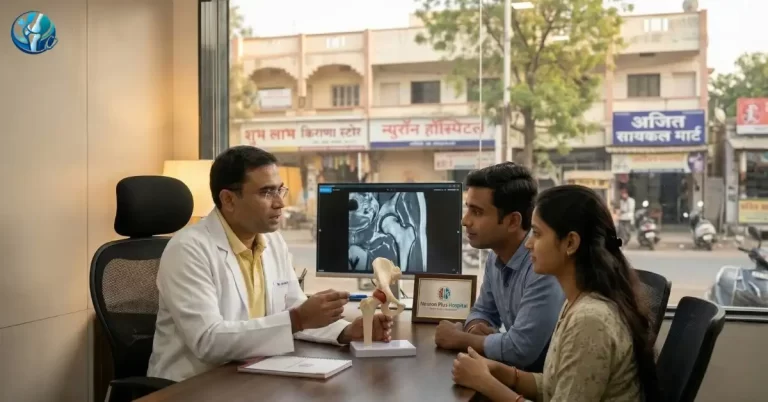
Many young and active adults in Ahilyanagar dismiss persistent groin pain as a simple muscle strain. You might pop a painkiller, rest for a weekend, and assume the ache will fade. But when that deep, throbbing pain refuses to leave, you are likely facing a hidden and aggressive condition: Avascular Necrosis (AVN) of the femoral head.
To stop the progression, you need to stop guessing. Masking the symptoms with over-the-counter medication only accelerates joint collapse. The immediate next step is recognizing the specific signs of AVN, such as stiffness or a noticeable limp, and securing a targeted MRI. Catching this condition in Stage 1 or Stage 2 is the only way to preserve your natural hip joint before the bone literally starves and dies.
At Neuron Plus Hospital, Dr. Avinash Gadekar regularly treats patients who waited too long to investigate their hip pain. As a specialized Orthopedic and Joint Replacement Surgeon, he has successfully diagnosed and managed hundreds of complex AVN cases. In the video below, Dr. Gadekar breaks down exactly how blood loss destroys the hip bone and the exact medical interventions required to fix it.
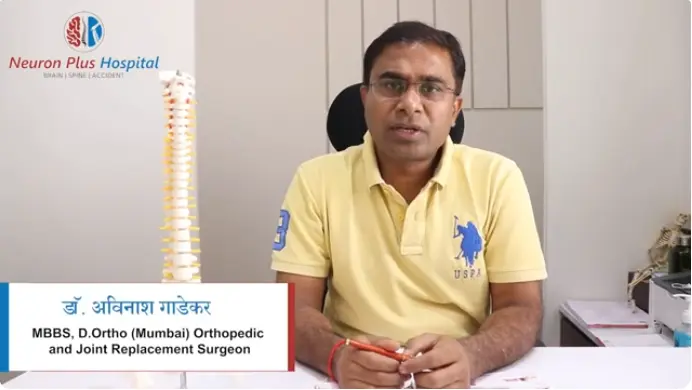
📌 महत्त्वाचे मुद्दे: खुब्यातील वेदना आणि AVN (Avascular Necrosis)
तरुण वयात खुब्यात किंवा मांडीच्या सांध्यात सतत दुखत असेल, तर त्याकडे साधी स्नायूंची दुखापत म्हणून दुर्लक्ष करू नका. हा ‘अव्हॅस्क्युलर नेक्रोसिस’ (AVN) म्हणजेच सांध्याला रक्तपुरवठा बंद होण्याचा गंभीर आजार असू शकतो.
डॉ. अविनाश गाडेकर (न्यूरॉन प्लस हॉस्पिटल, अहिल्यानगर) यांनी या आजाराची कारणे आणि योग्य उपचारांबद्दल वरील व्हिडिओमध्ये सविस्तर माहिती दिली आहे. योग्य वेळी MRI करून निदान झाल्यास तुमचा नैसर्गिक सांधा वाचवणे शक्य आहे. केवळ वेदनाशामक गोळ्यांवर अवलंबून न राहता त्वरित तज्ञांचा सल्ला घ्या.
Understanding Avascular Necrosis of the Femoral Head
Patients frequently confuse AVN with standard osteoarthritis. We need to separate the two conditions immediately because treating AVN like normal wear and tear will cost you your natural hip joint. Avascular necrosis of the femoral head occurs when the blood supply to the “ball” of your hip joint is interrupted.
To visualize this, think of your bones as living tissue that requires constant nourishment. When the blood flow stops, the bone tissue literally starves and begins to die. The structural integrity of the femoral head weakens. If left unchecked, the bone will eventually collapse under your own body weight.
Dr. Avinash Gadekar utilizes advanced MRI diagnostics at Neuron Plus Hospital to catch this bone death in its earliest phases. Standard X-rays often miss the initial damage, making specialized orthopedic evaluation critical for a timely diagnosis.
Core Symptoms of Avascular Necrosis You Should Never Ignore

Ignoring early pain signals is the fastest route to a total hip replacement. You must recognize how AVN pain differs from a simple groin strain or muscle pull.
You can identify AVN by tracking when and where the pain occurs. The symptoms are highly specific and typically worsen progressively rather than healing with rest.
Patients presenting at our Ahilyanagar clinic consistently report these exact symptom patterns during their initial consultations with Dr. Gadekar.
Deep Groin and Hip Pain
Groin pain is almost always the first red flag for AVN of the hip. You might feel a deep, throbbing ache that radiates down into your thigh or knee.
If this pain wakes you up at night or spikes violently when you put weight on the affected leg, you need an immediate clinical evaluation.
Our diagnostic data shows that patients who seek an MRI the moment this deep groin pain begins have the highest success rates with joint preservation techniques.
Stiffness and Reduced Mobility
As the bone tissue begins to die, the mechanics of your hip joint fail. You will notice a sudden and severe reduction in your range of motion.
Try crossing your legs or putting on your shoes and socks. If these simple daily tasks suddenly feel impossible due to stiffness in the hip crease, the joint is already compromised.
Dr. Gadekar performs specific rotational tests during physical exams to confirm this exact mechanical restriction before ordering imaging.
A Noticeable Limp
Your body will naturally try to protect a dying hip joint by shifting your weight. This results in an altered gait or a pronounced limp.
You must stop walking through the pain. Using a cane or crutches to offload the weight is a necessary temporary measure until you get a proper diagnosis.
Continuing to put full body weight on a compromised femoral head directly accelerates the bone collapse, turning a preservation case into a mandatory surgical replacement.
The 4 Crucial Stages of Avascular Necrosis
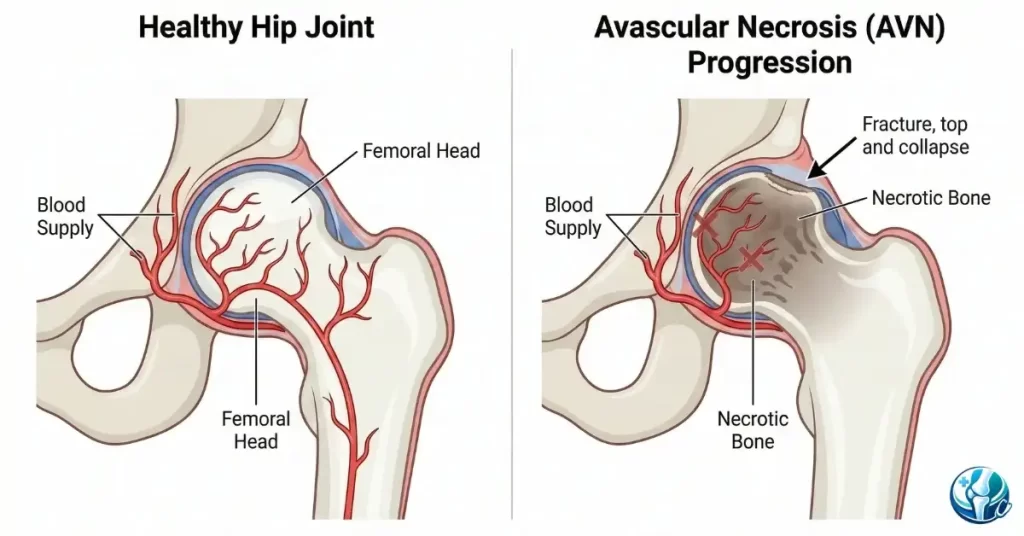
Patients constantly ask how fast avascular necrosis progresses. The timeline varies, but the structural degradation follows four distinct stages.
Understanding these stages dictates your exact treatment plan. You can track your progression based on clinical imaging and the severity of your pain.
Orthopedic specialists globally rely on the Ficat and Arlet classification system to stage AVN, a protocol strictly followed at Neuron Plus Hospital.
Stage 1 and 2: The Hidden Bone Damage
In the earliest stages, the bone is dying, but the spherical shape of the femoral head is still completely intact.
This is your window for joint preservation. You will feel pain, but a standard X-ray will look perfectly normal. You must demand an MRI to detect the bone marrow edema hidden inside the joint.
Dr. Gadekar successfully utilizes core decompression procedures during these early stages to stimulate new blood vessel growth and save the natural bone.
Stage 3: The Beginning of Joint Collapse
Stage 3 is the critical tipping point. The dead bone can no longer support your weight, and the femoral head begins to flatten and collapse.
The pain becomes constant and severe. At this stage, joint preservation is rarely viable. You will visibly see the “crescent sign” on a basic X-ray, indicating subchondral fractures.
Clinical evidence proves that once the femoral head collapses, the friction destroys the surrounding cartilage rapidly.
Stage 4: Severe Arthritis and Complete Immobility
This is the end stage of AVN. The femoral head has completely collapsed, and secondary osteoarthritis has destroyed the entire hip socket.
Your only option to eliminate the pain and walk normally again is a Total Hip Replacement (THR).
As a joint replacement surgeon, Dr. Gadekar routinely performs complex THR surgeries for Stage 4 AVN patients, restoring their mobility with highly durable implants.
What Causes Blood Loss to the Hip Joint?
AVN does not just happen without a catalyst. You need to understand the underlying triggers that choke off the blood supply to your bones.
You can prevent further joint damage by identifying and halting these risk factors immediately.
Medical literature and our own clinical case studies in Ahilyanagar highlight three primary culprits behind the vast majority of AVN diagnoses.
High-Dose Steroid Use
Corticosteroids are powerful anti-inflammatory drugs. However, prolonged or high-dose usage is the leading non-traumatic cause of AVN.
If you have been prescribed heavy steroids for conditions like asthma or autoimmune disorders, you must monitor your hip joints closely. Steroids increase lipid levels in your blood, creating fat emboli that block the tiny blood vessels feeding the femoral head.
We regularly collaborate with referring physicians to manage the orthopedic fallout of necessary life-saving steroid treatments.
Joint Trauma and Fractures
A severe physical impact can physically tear or crush the blood vessels supplying the hip bone.
If you have suffered a hip dislocation or a femoral neck fracture in a vehicle accident or severe fall, you are at a massive risk for AVN. You must attend follow-up scans for up to two years post-injury.
Trauma-induced AVN is a highly documented orthopedic complication that requires aggressive monitoring long after the initial bone fracture heals.
Excessive Alcohol Consumption
Patients often ask how much alcohol causes avascular necrosis. Chronic, heavy alcohol consumption directly leads to fatty deposits in your blood vessels.
You must be completely transparent with your surgeon about your alcohol intake. This fatty buildup restricts blood flow to the extremities and joints, starving the femoral head in the exact same manner as steroid use.
Clinical data definitively links long-term heavy drinking to a significantly higher incidence of bilateral AVN, meaning it will eventually destroy both of your hips.
Can Avascular Necrosis Be Reversed or Cured?
Patients desperately search for ways to reverse AVN without surgery. We need to set realistic clinical expectations immediately because false hope will cost you your mobility.
You cannot “cure” dead bone tissue with basic medication or wishful thinking. You must act during the earliest stages to preserve the joint using targeted orthopedic interventions. If the disease is caught in Stage 1 or early Stage 2, surgeons can perform a core decompression. This procedure involves drilling a small hole into the femoral head to relieve pressure and create a new pathway for blood vessels to nourish the starving bone. If the bone has already collapsed, a total hip replacement is your only medical option.
Dr. Avinash Gadekar rigorously evaluates every AVN patient at Neuron Plus Hospital. He utilizes advanced imaging to determine if joint preservation is mathematically viable before ever suggesting a joint replacement.
The Truth About Ayurvedic and Alternative AVN Treatments
Many patients in Ahilyanagar try to manage AVN with Ayurvedic remedies or temporary pain injections, losing critical time in the process. We must address this dangerous delay directly.
You can certainly use alternative therapies for temporary pain management, but you cannot regrow dead, necrotic bone tissue with herbal supplements or massages. You must secure clinical imaging to track the actual structural degradation of your hip while managing your symptoms.
Our clinical data at Neuron Plus Hospital shows a clear pattern. Delaying specialized orthopedic intervention in favor of alternative treatments frequently forces patients directly into Stage 4 AVN. This turns a potentially preventable condition into a mandatory reconstructive surgery.
When is Hip Replacement Surgery Necessary for AVN?
We must clearly define the endpoint of this disease. Patients frequently ask if a hip replacement actually cures avascular necrosis.
Total Hip Replacement (THR) is the definitive cure for Stage 3 and Stage 4 AVN. Once the necrotic bone is surgically removed and replaced with a high-grade titanium and ceramic implant, the disease is entirely eradicated from that specific joint. You can read exactly how this procedure works and what recovery looks like on our dedicated Joint Replacement Services page.
Dr. Gadekar’s precision alignment techniques during THR ensure patients regain full, pain-free mobility. His surgical protocols are designed to help you return to your active lifestyle, free from the debilitating limitations of a dying hip joint.
Reclaim Your Mobility in Ahilyanagar Today
You cannot afford to wait and see if severe groin pain will simply vanish.
Stop living with excruciating pain that limits your ability to walk, sleep, and work. If you suspect you are showing the early signs of AVN, you need an immediate diagnostic evaluation. A delayed MRI is the difference between saving your natural hip and requiring a total joint replacement.
Contact our administration desk at Neuron Plus Hospital to schedule your priority consultation. As a leading Orthopedic and Joint Replacement Surgeon in Ahilyanagar, Dr. Avinash Gadekar provides transparent, package-based pricing and world-class surgical outcomes tailored to your exact condition.
Frequently Asked Questions About AVN of the Hip
Q1. How long can you live with avascular necrosis?
Ans: AVN is not a terminal illness, so it will not reduce your natural lifespan. However, if left untreated, it will severely destroy your quality of life. The bone death will eventually cause your hip joint to collapse, leading to chronic, debilitating pain and a complete loss of mobility.
Q2. How fast does avascular necrosis progress?
Ans: The progression timeline varies drastically between patients depending on the underlying cause. Without clinical intervention, AVN can completely destroy a healthy hip joint and progress from Stage 1 to Stage 4 in as little as a few months or up to a year. Early diagnosis via an MRI is your only defense to slow down this rapid joint destruction.
Q3. What is the best treatment for avascular necrosis of the hip?
Ans: The optimal treatment depends entirely on the current stage of your bone collapse. In the early stages, Dr. Avinash Gadekar utilizes core decompression surgery to save your natural bone and restore blood flow. Once the femoral head physically collapses in Stage 3 or Stage 4, a Total Hip Replacement is the absolute gold standard to eliminate the pain and restore your full range of motion.
Q4. Can avascular necrosis be reversed without surgery?
Ans: You cannot reverse dead bone tissue with painkillers, physical therapy, or alternative remedies. While conservative treatments might temporarily mask the pain, they do not restore the blocked blood flow to your femoral head. Clinical surgical intervention is required to either preserve the dying bone or replace the collapsed joint entirely.
Q5. Is avascular necrosis considered a disability?
Ans: Advanced AVN severely restricts your physical capabilities. It can lead to long-term disability if the pain prevents you from walking, climbing stairs, or performing your daily job. Once the hip joint collapses, you will likely require mobility aids like a cane or crutches. A successful joint replacement surgery is the most effective way to eliminate this disability and return to a normal, active lifestyle.